Posts

Showing posts with the label #ITManagement

IT#21 New Hire Dilemma - The Better the Company the Worse is Your First Team
Image
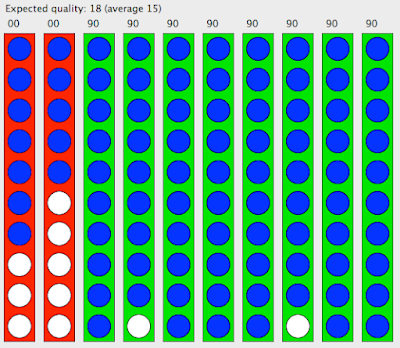
 #IT, #ITManagement, #ITManagementTheory, #ITHiring, This article explains that in some cases getting hired by a great company is not a guarantee of a great team or a manager, and sometimes actually the opposite. Imagine that you've got hired by a great company, at least so “The Best Employee” polls say. Great, is not it? Don't jump to conclusions yet. Let's look how it works inside. First let's create a model. Assume the company has 10 teams with 10 positions in each. Also, assume that all teams are filled 90%, and so each team has one headcount. By the way, this model is implemented in Java and available on the GitHub  (it was actually first done around 2010, and I re-implemented it in 2023). Now, remember? The company is great! Which means most of the teams are good. But the cannot be all good, so let's assume a couple of them is bad. Let's say, 90 (green) is good, and 0 (red) is bad. What will we have after N iterations? Here it is: You see, two things are h...

IT#19 The Most Expensive Storage in IT (and how to use it)

Image
#IT Management #ITHiring #SoftwareEngineering A story Long ago in 1998 I was interviewed by a guy from one Chicago company about C++ and MFC (Microsoft UI library for C++). He asked me: "How would you put 50000 items in UI into a dropdown box." "I would not put 50000 items into a dropdown box." "But what if the customer wants that?" "Then I would talk to the customer and explain why this is a bad idea." "But still..." The guy wanted a hack. Specifically, he wanted to implement scrolling event handlers and dynamically update the list. He clearly was very proud of knowing about those interceptors and his goal in the interview was to show that. I know, odd for an interviewer. The idea itself was horrible, it’s expensive to implement and maintain and the result would be... inferior. For example, the slider would jump around when scrolling. But this is not why the idea was bad. As I wrote before, all Computer Science and things like GUI are ...

IT#15 Why Servitude Society Conflicts with The Knowledge Economy and What to Do About That

Image
#Economy #Socium #SocialSystem #ITManagement This article explains a different classification of human social systems – cooperative, imperative and servitude, and show why the dominating today servitude system conflicts with the Knowledge Economy and Knowledge Age. It also suggests what to do about that. A different classification of social systems In the article devoted to the knowledge economy we used a most popular today classification of social systems “hunter-gatherers”-slavery-feudalism-capitalism-socialism. This classification is based on economic relationships between people. By meaning it comes to Karl Marx, even though he did not really used words “capitalism” or even “socialism”. While that system is certainly important, we will use today a very different classification of social systems based on the reasons why people stay in society. This is cooperative-imperative-servitude classification . Cooperative society is when cooperation is the reason why people stay inside. A sma...

IT#14 Economy of Complexity

Image
The Paperwork Reduction Act (PRA) is a United States federal law enacted in 1980 designed to reduce the total amount of paperwork burden the federal government imposes on private businesses and citizens. United States Federal Law enacted by the 96th United States Congress. Effective December 11, 1980. #ITManagement #Management #Economy #ParasiticLoops #Complexity #TechnicalDebt This article explains the phenomenon of Economy of Complexity, its kinds and when does it become really bad. What is Economy of Complexity? What is this, Economy of Complexity? To make it short, the economy of complexity appears when a significant cost for a customer comes not from the materials and labor costs, but rather from the artificially raised beyond measure complexity of the process, service or a product . The classic example of the economy of complexity is bureaucracy. Imagine that you live a couple of centuries earlier than our time and come to some small European city to an insignificant city clerk w...

IT#10 Office Evolution and Unnatural Selection

Image
#KnowledgeEconomy #DiscoveryEconomy #ITManagement #Management #SocialNetworkEffects #UniversalEvolution This article explains why any knowledge economy company represents an evolutionary environment, why this is important, and how it works with the factors which affect the market fit of your company. The topic is most likely of interest for managers or CEOs. This is done using a computer simulation model. Really? Office Evolution? Yes. Check other articles on this site. There is a theory of universal evolution which applies generic principles of evolution to non-biological systems. It says that you have evolutionary environment whenever you have: A limited pool of resources, e.g. an ecological niche, audience or salary fund. A number of entities that compete for this pool of resources. Eventual demise and reproduction of these entities with sort of inheritance and mutations. A typical business satisfies all these conditions. It has: A limited salary and bonus fund. Employees compete fo...