Posts

Showing posts with the label #Economy

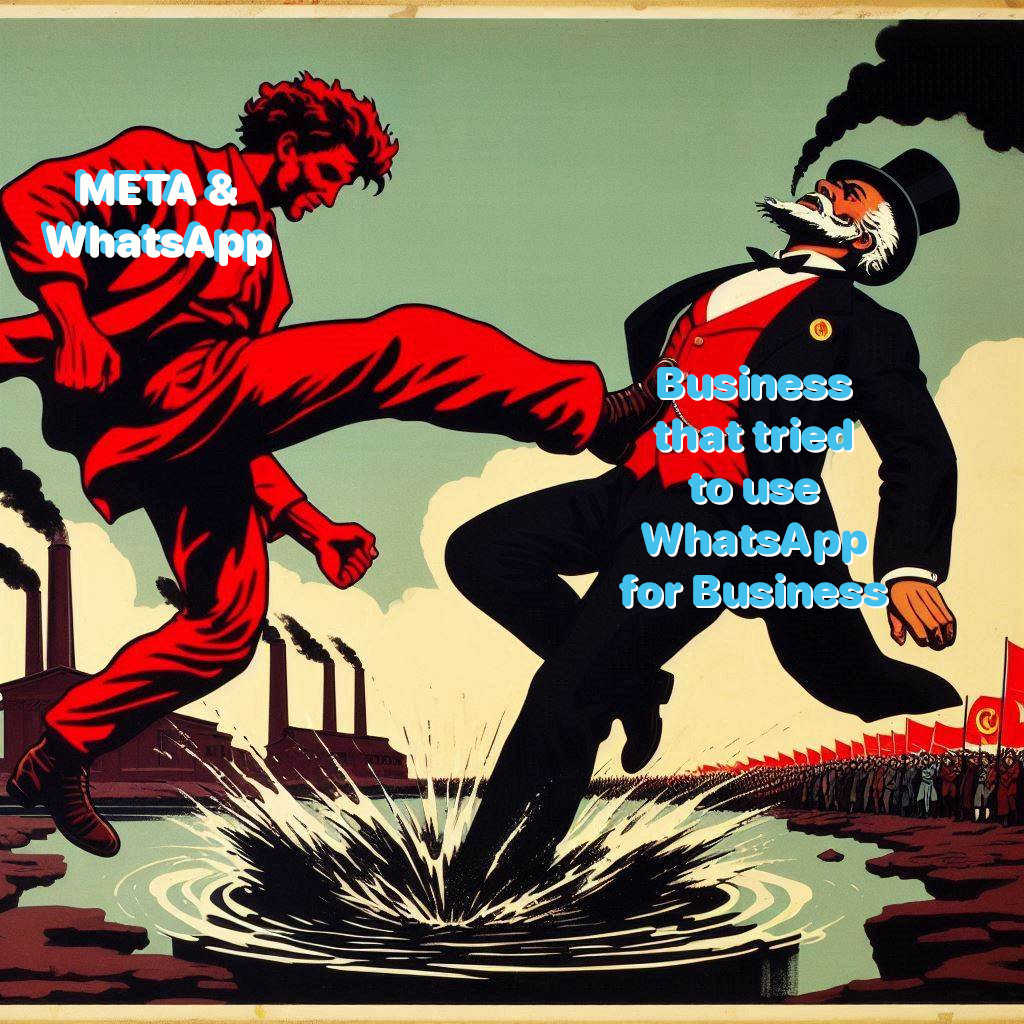
#24 Never use WhatsApp for Business… for business
Image
  #24 Never use WhatsApp for Business… for business Never use WhatsApp for Business… for business. Why? Let me tell you a story. Background It looks like most companies are unable to get out of their core competency and at best can only become second best to real leaders. Let’s consider the history. IBM core competency was mainframes and consulting. They were innovative enough to invent a personal computer, but were they able to monetize that advantage? No. They just did not get it. And their OS/2 attempt to enter PC software business was an ultimate failure. Not to mention that their Lotus suite is only remembered today by industry veterans. Long story short, they sold their PC business to Lenovo in 2005. R.I.P. IBM PC business. Microsoft instead was able to utilize the competitive advantage of PCs. Their core competency was the common OS and Office applications. They did not care who makes PCs as log as they were running Windows and MS Office. Microsoft was also the ...

IT#15 Why Servitude Society Conflicts with The Knowledge Economy and What to Do About That

Image
#Economy #Socium #SocialSystem #ITManagement This article explains a different classification of human social systems – cooperative, imperative and servitude, and show why the dominating today servitude system conflicts with the Knowledge Economy and Knowledge Age. It also suggests what to do about that. A different classification of social systems In the article devoted to the knowledge economy we used a most popular today classification of social systems “hunter-gatherers”-slavery-feudalism-capitalism-socialism. This classification is based on economic relationships between people. By meaning it comes to Karl Marx, even though he did not really used words “capitalism” or even “socialism”. While that system is certainly important, we will use today a very different classification of social systems based on the reasons why people stay in society. This is cooperative-imperative-servitude classification . Cooperative society is when cooperation is the reason why people stay inside. A sma...

IT#03 Discovery Economy

Image
 #Economy, #KnowledgeAge, #KnowledgeEconomy, #DiscoveryEconomy, #SocialSystems This article introduces the idea of Discovery Economy which seems to take a root in the world economy. Parable preface In a far far away land, there was a very lonely king. So, he wanted to marry a princess. He had heard of one locked in the highest room of the tallest tower of a castle guarded by a fire breathing dragon. The king did not have time for such technicalities as killing a dragon or finding the princess and the castle in the first place, so he called the Hero and asked him to rescue the princess and bring her to him. - Sure thing, Your Majesty, - said the Hero, - but I’ll need some time and road expenses. - Talk to my Treasurer, he will provide you for the road, - casually dropped the king and turned to more important things to do. - It does not work this way, - said the Treasurer self-importantly, - Write the Design. Where will you go, which cities you will visit, how much room and fo...

IT #2 Knowledge Economy

Image
#KnowledgeEconomy #KnowledgeAge #KnowledgeWorkers #Economy #SocialSystems #BoringBackground This article explains what knowledge economy is and provides the background info necessary for that explanation. Preface In 1959 “the father of American corporate management” Peter F. Drucker introduced a term “knowledge workers” in his book “The Landmarks of Tomorrow”. Basically, he noticed that since the World War II, we’ve got a lot of workers who could not be managed in the old, Industrial Age, ways. “Scientific Method” of Taylor1 simply did not work anymore with these workers. And the suggestion was to manage them differently. Later a lot of other people contributed to how it could be done, and it’s still very much work in progress. Adding to that statement, it’s fairly clear why it did not work. Tailor’s method was to split a complicated process, like creation of optical lenses or arsenal workers. With knowledge workers splitting work into tiny steps on one project did not work, because on...

IT#14 Economy of Complexity

Image
The Paperwork Reduction Act (PRA) is a United States federal law enacted in 1980 designed to reduce the total amount of paperwork burden the federal government imposes on private businesses and citizens. United States Federal Law enacted by the 96th United States Congress. Effective December 11, 1980. #ITManagement #Management #Economy #ParasiticLoops #Complexity #TechnicalDebt This article explains the phenomenon of Economy of Complexity, its kinds and when does it become really bad. What is Economy of Complexity? What is this, Economy of Complexity? To make it short, the economy of complexity appears when a significant cost for a customer comes not from the materials and labor costs, but rather from the artificially raised beyond measure complexity of the process, service or a product . The classic example of the economy of complexity is bureaucracy. Imagine that you live a couple of centuries earlier than our time and come to some small European city to an insignificant city clerk w...